


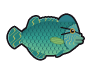

About this group
Wrasses make up the family Labridae. They were long placed in the order Perciformes, though some scientists now give them an order of their own, Labriformes. Parrotfishes used to have a separate family too, but genetic studies have shown that they sit inside the wrasse family, and they are now widely counted as wrasses. Including the parrotfishes, there are a little over 600 species.
Most live in shallow tropical and subtropical waters of the Atlantic, Indian and Pacific oceans, mainly on coral reefs and rocky shores. Some live in cooler seas as well, reaching as far north as the coast of Norway.
Bodies
A wrasse’s mouth can shoot forward, and its teeth stand apart from one another. Many species have sharp, canine-like teeth sticking out at the front, and thick lips are common.
Further back, in the throat, sits a second set of jaws, the pharyngeal jaws. Prey caught by the mouth can be crushed here, so wrasses can eat animals with hard shells, such as snails and crabs.
Wrasses are also known for changing colour as they grow. In many species, young fish and females look completely different from large males. In Japan, the females and males of one common species, Halichoeres poecilopterus, even have separate local names: the “red wrasse” and the “blue wrasse”.
Ways of life
Most wrasses eat small animals such as crabs, shrimps, snails, worms and sea urchins. Some, like the bluestreak cleaner wrasse, make a living picking parasites off other fish. Parrotfishes scrape algae off rock and dead coral with their beak-like teeth.
Many wrasses change sex. Most species start adult life as females and later become males. Many form harems in which one male lives with several females; in the bluestreak cleaner wrasse, if the male disappears, the largest female changes sex and takes his place.
Most are active by day and sleep at night. Some species bury themselves in the sand to sleep, and the Halichoeres poecilopterus mentioned above also spends the cold winter months resting in the sand. Others tuck themselves into crevices in the rock. Some parrotfishes wrap themselves in a sleeping bag of mucus, released from a gland near the gills.
Telling them apart
The closest relatives, the parrotfishes, are told apart by their teeth. Wrasses have separate teeth and a mouth that can be pushed forward. Parrotfishes have teeth fused into a beak like a parrot’s. A few parrotfishes have separate teeth, though, so some fish can be tricky.
Other fish can imitate wrasses as well. The false cleanerfish, a blenny, looks almost exactly like the bluestreak cleaner wrasse.
People and these fish
With so many brightly coloured species, wrasses are widely kept as aquarium fish and are a common sight in the reef tanks of public aquariums.
Some are eaten. Along the Seto Inland Sea in Japan, Halichoeres poecilopterus is known locally as gizami and is enjoyed simmered or marinated.
The largest wrasse, the humphead wrasse, has been overfished because it fetches very high prices in the live reef fish trade, and its numbers have fallen sharply. It is listed as Endangered on the IUCN Red List, and since 2004 its international trade has been controlled under CITES.
The cleaning habit of wrasses has even found a use in fish farming. In Norway and elsewhere, wrasses are put into salmon pens to eat sea lice, parasites that attach to the salmon. Most of these wrasses are caught from the wild, which has raised concerns about the effect on wild populations.