




About this group
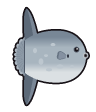
The order Tetraodontiformes brings together the pufferfishes, porcupinefishes, boxfishes, triggerfishes, filefishes, ocean sunfishes and a few smaller families. Scientists divide it slightly differently, but there are about 10 families and a little over 400 species.
Almost all live in warm seas around the world, mostly in shallow places such as coral reefs, rocky shores and sandy bottoms. Ocean sunfishes drift in the open ocean, some families live in deep water, and a few pufferfishes spend their whole lives in fresh water.
Bodies
The feature they share most clearly is the mouth. The teeth are fused into plates that form a strong beak, able to crack the shells of snails, crabs and sea urchins. Pufferfishes have four plates, while the porcupinefish and its relatives have two, and both families take their scientific names from these counts.
The gill covers are hidden under skin, leaving only a small opening in front of the pectoral fin. Scales have become bony plates in boxfishes and long spines in porcupinefishes, while filefishes and ocean sunfishes have tough, rough skin. The pelvic fins are missing or reduced to tiny remnants.
Most swim with a fairly stiff body, fluttering the dorsal, anal and pectoral fins. They are not fast, but they are good at holding still and making small, precise turns.
Pufferfishes and porcupinefishes puff up by quickly pumping water into a stretchy stomach, which makes them much harder to swallow.
Ways of life
Most feed on small animals with shells or spines, such as snails, crabs, sea urchins and worms, prey that many other fish cannot handle. The ocean sunfish is the odd one out, feeding mostly on jellyfish and other soft animals in the open sea.
Breeding habits vary. Triggerfishes such as the Picasso triggerfish lay eggs on sandy ground, and a parent stays nearby to guard them. Off Amami Ōshima in southern Japan, males of a small pufferfish, Torquigener albomaculosus, sculpt round, patterned nests in the sand about 2 m across. For years nobody knew what made these “underwater crop circles”.
Telling them apart
- Pufferfishes: four tooth plates. Any spines are small and usually hidden. They inflate.
- Porcupinefishes: two tooth plates. Long spines that stand up when the fish inflates.
- Boxfishes: enclosed in a rigid shell of bony plates, like the longhorn cowfish and yellow boxfish.
- Triggerfishes: three spines at the front of the dorsal fin; the second locks the first upright.
- Filefishes: usually two dorsal spines, the second very small. Flat bodies with rough skin.
People and these fish
Pufferfishes are famous for tetrodotoxin, a powerful nerve toxin found mostly in the liver and ovaries and, in some species, in the skin or muscle. Ordinary cooking does not destroy it, and there is no reliable antidote. The fish do not make it themselves: it is thought to come from marine bacteria and build up through the animals they eat. Farmed pufferfish raised on toxin-free food carry little or no toxin.
In Japan, the government decides which species, parts and fishing areas are allowed for food, and only people approved by each prefecture may prepare pufferfish. Even so, poisonings, mostly from fish prepared by untrained people, still happen almost every year.
Filefishes are a popular food fish in Japan; their Japanese name, kawahagi, means “skin peeler”, because the tough skin is removed before cooking. Boxfishes, when stressed, can release a skin toxin that harms other fish nearby.
Ocean sunfishes are the heaviest bony fish, with records of over two tonnes. With so many comical shapes, this group is a favourite in public aquariums and with divers.