
About
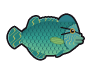
This is the largest of all wrasses. It has a deep, heavy body, and as it grows, the forehead above the eyes swells into a big rounded hump. Seen from the side, it looks as if the fish is carrying a lump on top of its head. The hump is most obvious in old, large fish, especially males.
The body is blue-green to green, and every scale carries a dark vertical mark. Because the scales sit in neat rows, these marks add up to a fine pattern of wavy lines across the whole body. The head is bluer, with thin yellowish squiggles spreading out from around the eye. Behind each eye run two dark lines, angled slightly apart, and a shorter line runs forward from the eye toward the snout.
The mouth has big, thick lips. Deep in the throat are strong crushing teeth (pharyngeal teeth), thought to let it crack the shells of snails and sea urchins. The tail is rounded at the back, and the rear parts of the dorsal and anal fins are rounded too. Young fish are pale with bold dark lines, and gradually take on the blue-green colors of the adult.
Name
“Humphead” describes the forehead. Another English name, “Maori Wrasse,” compares the lines on its face to Maori facial tattoos. Divers and aquariums often call it the “Napoleon fish” (in Japan too), because the hump is said to resemble the two-cornered hat Napoleon wore.
Its Japanese name, Megane-mochi-no-uo, means roughly “spectacled mochi-no-uo”: the lines around the eye are likened to glasses, and mochi-no-uo is the name used for this genus of wrasses.
The genus name Cheilinus comes from the Greek word for “lip,” a nod to its thick lips. The species name undulatus means “wavy,” after the wavy lines on the body.
Life
It lives on tropical coral reefs across the Indian Ocean and Pacific, but it is never common anywhere. Juveniles hide among branching corals and seagrass in lagoons and sheltered bays. As they grow they move out to the steeper outer reef slopes and channels where the water flows well. Most are seen from a few meters down to a few tens of meters, and occasionally as deep as about 100 m.
It usually swims slowly on its own or in small numbers. It is active by day and rests in crevices or caves at night. Individuals keep to a home range, so divers can meet the same fish in the same place again and again.
It feeds mainly on hard-bodied animals living on the bottom: mollusks, crabs and shrimps, sea urchins, and small fish. It is known for eating animals most other fish avoid because of toxins or spines, and has been reported eating the coral-eating crown-of-thorns starfish, boxfishes and sea hares.
It starts life as a female and later changes into a male (protogynous hermaphroditism). It takes more than five years to mature and is thought to live about 30 years. In the breeding season, fish gather at set sites to spawn. Because it grows slowly and matures late, its numbers recover only slowly.
Look-alikes
The Bumphead Parrotfish, found on the same reefs, is another giant with a bulging forehead and is sometimes confused with it. The parrotfish has front teeth fused into a beak, and its hump juts forward almost vertically from the forehead. Its body is grayish green, without the fine wavy lines or the dark lines behind the eye. Bumpheads also tend to move in groups, while the Humphead Wrasse is usually alone.
The tiny Bluestreak Cleaner Wrasse could hardly look more different, but it belongs to the same family.
People and this fish
It is not very shy, and sometimes drifts up close to divers, which makes it a favorite at dive sites such as Palau, the Great Barrier Reef and the Red Sea. Some large public aquariums keep it too.
At the same time, it fetches very high prices as a luxury food fish, especially in the live reef fish trade, and it has been heavily fished in many places. Because it grows slowly and breeds late, populations are slow to recover. It is listed as Endangered on the IUCN Red List, and is in Appendix II of CITES, which regulates international trade. Like other large reef predators, it can also cause ciguatera, a type of fish poisoning, when eaten.
In Fish Around
To match the way it slowly patrols the reef, it uses the steady “cruise” motion. As a large species, it swims more slowly than most fish and appears bigger on the screen.
The hump is drawn by placing a tall oval on top of the head, so it rises above the line of the back. A dark vertical mark on each scale builds up the fine wavy pattern on the body. The two dark lines behind the eye, the short line in front of it, the yellow squiggles on the head, the thick lips pushing forward and the rounded tail are all drawn in.


