About
This is a wrasse you can recognize from a long way off: a pale body crossed by a row of bright orange bands. There are about three bands on the head and about five on the body, and each one is edged in blue. The background color runs from white to pale bluish white, turning bluer along the back. Toward the rear, near the base of the tail, the body is often darker, and the stripes fade out there.
The dorsal and anal fins are orange with a blue line along the edge. The tail is orange to reddish, and the pectoral fins are pale yellow. The body has the oval outline typical of wrasses, but it is a little deeper than that of the slender wrasses, which gives it a sturdy look.
Its most striking feature is its mouth. At the front of the upper and lower jaws are large, tusk-like teeth that point forward — and they are blue. When the fish opens its mouth slightly, the blue tusks show between orange lips. The name “tuskfish” comes from these teeth. They are thought to help the fish grip hard-shelled prey and pull it off rocks. In young fish the teeth are not very blue; they are said to darken as the fish grows.
Most adults are about 20–25 cm long, and large ones reach about 30 cm. Fish from Australia are often said to be more richly colored, with crisper bands, than those from Japan and Taiwan.
Name
“Harlequin” compares its bands to the patchwork costume of the clown character of old European comedy. “Tuskfish” refers to the teeth.
The species name fasciatus is Latin for “banded,” pointing to the stripes on the body. The “-odon” at the end of the genus name Choerodon comes from the Greek word for “tooth,” a nod to the prominent teeth of the group. Fish in the genus Choerodon are known together in English as tuskfishes.
Life
The harlequin tuskfish lives on coral reefs in the western Pacific, but its range is split in two. One part runs from the Ryukyu Islands of southern Japan to Taiwan; the other runs from northeastern Australia, including the Great Barrier Reef, to New Caledonia. In the wide stretch of ocean between them it is rarely found.
It lives at depths of about 5 to 35 m. It prefers reef slopes and places where rocks and coral heads are piled up, and it is often seen near overhangs and caves. It usually lives alone or in small, loose groups, and it is said to keep to a home area.
It feeds on small, hard-shelled animals living on the bottom: snails and clams, crabs, shrimps and other crustaceans, sea urchins and worms.
Some of its relatives are known for smashing shellfish against rocks. In 2011 a blackspot tuskfish on the Great Barrier Reef was photographed beating a clam against a rock again and again until the shell broke — a much-discussed example of a wild fish using a tool. Since then, several other species in the same genus have been recorded using rocks or hard coral as an anvil to crack prey. Whether the harlequin tuskfish does the same is not clearly known.
Like many wrasses, it is thought to change sex: all fish start life as females, and larger ones later become males. If the dominant male disappears, the largest female is said to take his place.
Look-alikes
Orange-and-white stripes may bring the clownfish to mind, but the colors are arranged the other way around. The clownfish has three white bands on an orange body, edged in black. The harlequin tuskfish has more bands, and they are orange on a pale body, edged in blue. The two fish also differ completely in size and shape, and only the tuskfish has blue tusks.
Fellow wrasses such as the yellowtail coris and the humphead wrasse have no stripes and are easy to tell apart.
People and this fish
Its colors and unusual blue teeth have long made it a popular marine aquarium fish. It is known as a hardy fish, but it grows fairly large, can be bold toward tankmates and will eat shrimps, crabs and other small animals, so keeping it is said to call for a large tank and care in choosing its companions.
It is sometimes shown in tropical reef tanks at public aquariums, and divers can meet it among the rocks in Okinawa and on the Great Barrier Reef.
On the IUCN Red List it is assessed as Least Concern. Even so, it is exposed to collection for the aquarium trade and to changes in the health of the coral reefs it depends on.
In Fish Around
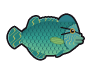
The sprite has a slightly deep wrasse body with three orange bands on the head and five on the body. The body bands have blue edges, but the head is small, and adding edges there made the bands blur together, so the head bands are plain orange with white showing between them. The eye sits in a white gap between bands.
From the tip of the snout, one blue tusk points forward from each jaw, slightly apart, as if the mouth were a little open. They are drawn more boldly than in life so that you can tell this is a fish with tusks even at a small size. The fins are orange with blue edges, the tail has a red trailing edge, and the pale yellow pectoral fin lets the body color show through.
For its movement it uses “dart”: short dashes and pauses, like a fish that searches among the rocks for prey and then moves quickly to the next spot.