About
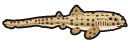
A pale yellowish-brown shark covered in round, dark brown spots, like a leopard. The first thing most people notice is the tail: a low, very long caudal fin that makes up almost half of the animal’s total length. The body is a thick cylinder with five ridges running along the back, one down the middle and two on each side, so from the side it looks as if lines have been drawn along its flanks.
The head is short and rounded, with the mouth on the underside near the front. A pair of short barbels at the tip of the snout is thought to help it feel for food on the sand. The eyes are small, and just behind each one is a larger opening called a spiracle. Spiracles draw in water, and they are thought to let the shark keep pumping water over its gills while it lies still on the bottom.
The spots are not the pattern it is born with. Young zebra sharks look completely different: dark with pale yellow or white vertical stripes. As they grow, the stripes break up into spots, and by the time they reach around 50–90 cm long they wear the adult leopard pattern.
Name
The English name “zebra shark” comes from those juvenile stripes, which is why it can seem puzzling when you only see an adult. In Australia and elsewhere it is also called a “leopard shark” because of the adult spots. The Japanese name, torafu-zame, means “tiger-mottled shark.”
The genus name Stegostoma means “covered mouth” in Greek, and the species name tigrinum means “tiger-like.” For a long time the species was known as Stegostoma fasciatum (“banded”), but a review of its naming around 2019 settled on tigrinum, so older books may still use fasciatum.
It is the only species in its family. It belongs to the carpet shark order (Orectolobiformes), which also includes the whale shark and the nurse sharks.
Life
Zebra sharks live in warm waters from the Indian Ocean to the western Pacific, usually on sand and rubble around coral reefs in fairly shallow water. In Japan they are found in the south, especially around Okinawa.
They are active at night. During the day they rest on the sand, propped up on their pectoral fins, often facing into the current. After dark they start to move, wriggling their slender bodies into cracks in the reef and gaps between rocks to hunt.
They eat snails and clams, shrimps, crabs and other crustaceans, and small fish. They are thought to use strong suction from the mouth to pull prey out of the holes where it hides.
Zebra sharks lay eggs. Each egg is wrapped in a large, dark brown case, and fine fibres on its surface tangle around objects on the seabed to hold it in place. In aquariums, there are reports of females kept away from males laying eggs that hatched into young. This is thought to be parthenogenesis — reproduction without a male — and it drew attention as one of the surprises of shark biology.
Look-alikes
Another fish called the “leopard shark” is Triakis semifasciata, a houndshark from the Pacific coast of North America. It has dark saddle-like bands as well as spots, its tail is not nearly as long, and it lives in a completely different part of the world.
The tawny nurse shark, another carpet shark, also rests on the bottom by day and is brownish, but it has no spots and no ridges along its back.
The Fish Around catalog also has the whale shark, a close relative that also has ridges along its body, and the bullhead shark, another shark that lives near the bottom.
People and this fish
Zebra sharks are gentle and almost never a danger to people. Because they spend the day lying quietly on the sand, divers can watch them up close, which makes them a favourite on reef dives. They are also kept in aquariums, including in Japan, where you can see them resting on the floor of the tank.
At the same time, they have been caught in fishing nets across their range, and taken for food and for their fins. Living on shallow reefs also exposes them to damage to their habitat. The IUCN Red List classifies the species as Endangered. In places such as Indonesia, projects have begun releasing aquarium-bred young into the sea to help rebuild wild populations.
In Fish Around
To fit the tail, which is about half of the body length, the sprite is extra wide. Round dark brown spots are scattered over a pale yellowish-brown body, and the ridges on the back and flanks are drawn as light lines. The head has a small eye with a larger spiracle just behind it, plus a short barbel at the tip of the snout. It uses the steady “cruise” movement at a slow speed: the head barely moves while the body bends more and more toward the tail, like a zebra shark wriggling slowly along near the bottom.