About
The largest fish in the world. Most are around 10 m long, large ones pass 12 m, and there are records of about 18 m. Despite the name, it is not a whale at all but a true shark that breathes through gills.
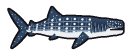
Its dark blue-grey back is covered in white spots and pale lines that cross to form a checkerboard pattern, while the belly is whitish. No two whale sharks have quite the same spots, so researchers identify individuals by comparing photos.
The head is broad and flat, with a huge, straight mouth right at the front. Inside are hundreds of rows of tiny teeth, but they are thought to play almost no part in eating.
It is a filter feeder. Sometimes it swims along with its mouth open so that water rushes in; at other times it stays put and gulps water in, working its mouth like a pump. The water flows out through the gills, and a sieve-like structure there holds back the food. Only three species of shark are known to feed this way, and the whale shark is one of them.
Name
The Japanese name, jinbei-zame, comes from the jinbei, a light summer garment whose pattern the shark’s markings are said to resemble.
It has many other local names in Japan. Along the Pacific coast of the Tohoku region, for example, some fishing communities call it Ebisu, after the god of fishermen (more on this below).
The English name simply means a shark as big as a whale. It was first described to science in 1828, from a specimen caught off South Africa.
Life
It lives in warm seas around the world, from the tropics to warm temperate waters, and rarely enters water much colder than about 20 °C. It spends most of its time near the surface but sometimes dives deep: one was recorded at more than 1,900 m.
It travels long distances across the open ocean. It swims slowly, sweeping its big tail from side to side. Usually it is alone, but in seasons when food is plentiful, dozens or even hundreds gather at particular sites. Ningaloo Reef in Western Australia and the waters off Mexico’s Yucatán Peninsula are among the best known.
It eats krill and other small crustaceans, fish eggs, small fish such as sardines and anchovies, and small squid.
Much about its breeding is still a mystery. In the 1990s, a female was found carrying around 300 young, which showed that the eggs hatch inside the mother and she gives birth to live pups.
Look-alikes
The other giant filter-feeding shark is the basking shark (Cetorhinus maximus), the second-largest fish in the world. It prefers cool temperate seas, has no white spots and has gill slits so long that they almost circle its head, so the two are easy to tell apart.
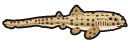
The Fish Around catalog also has the giant manta ray, another giant that strains plankton from seawater, and two more sharks: the scalloped hammerhead and the bullhead shark.
People and this fish
Fish such as skipjack tuna often gather around whale sharks. Fishermen in parts of Japan noticed this long ago, and a sighting came to be seen as a sign of a big catch; in some places the shark was honoured as a messenger of Ebisu.
In Japan, both Okinawa Churaumi Aquarium and the Osaka Aquarium Kaiyukan have kept whale sharks on display for many years. Churaumi has kept the same male since 1995, which is said to be the longest any whale shark has lived in captivity. Around the world, tours to snorkel or dive alongside whale sharks are popular. It is gentle and harmless to people, although touching it is banned in many countries.
Its numbers, however, have fallen sharply. The main causes are fishing for its fins, meat and liver oil, accidental capture in nets set for other fish, and collisions with ships. The IUCN Red List classes it as Endangered, and international trade in it has been controlled under CITES since 2003.
In Fish Around
Drawn as a wide sprite to match its size, it cruises along at an unhurried, steady pace, slowly sweeping its big crescent-shaped tail. The idea is a real whale shark ambling along near the surface with its mouth open.