About
A gentle little shark with a short, rounded head and ridges above the eyes, found along the coasts of Japan and nearby. Its brownish body is marked with a dozen or so irregular darker bands, which help it blend in on rocky, weedy sea floors.
Its two dorsal fins are tall, and each has a hard spine on its leading edge. It is thought that these spines can catch in the throat of a bigger fish trying to swallow it.
Its most remarkable feature is its teeth. At the front of the mouth are small pointed teeth for gripping, and at the back are flat, molar-like teeth for crushing. It grabs its prey with the front teeth and grinds it, shell and all, with the back ones — very different from the blade-toothed sharks most people picture.
Name
“Bullhead” refers to its thick, blunt head, which reminded people of a bull. In Japanese it is called neko-zame, “cat shark”, because its round head and eye ridges look like a cat’s face. The same face is a bull in English and a cat in Japanese. Because it crunches up turban snails, it also has the Japanese nickname sazae-wari, “turban-shell breaker”.
The genus name Heterodontus means “different teeth” in Greek, after its two kinds of teeth. The species name japonicus means “of Japan”; it was first described from a fish caught off Tokyo.
Life
It lives in shallow waters over the continental shelf from Japan and Korea along the coast of China, on rocky bottoms, reefs and kelp beds roughly 6 to 37 m deep.
It is a bottom-dweller and rarely swims far. When hunting, it moves its pectoral and pelvic fins in turn to “walk” across the sea floor.
It eats crabs, shrimp and other crustaceans, shellfish, sea urchins and small fish. Animals with hard shells suit it best, since its molar-like teeth can crack them open.
This shark lays eggs, each wrapped in a tough case. Thin flanges spiral three times around the case, so it looks like the tip of a drill. In Japan, females lay their eggs two at a time over several rounds between about March and September, most of all in March and April. The eggs are wedged among rocks or seaweed about 8–9 m deep, and several females may use the same spot: one nest was found with about 15 eggs. The mother leaves as soon as she has laid them and does not look after them. The eggs take about a year to hatch, and the pups are about 18 cm long when they emerge.
Look-alikes
There are several species of bullhead shark around the world, all with a rounded head and spines on the dorsal fins. The Port Jackson shark (Heterodontus portusjacksoni) of southern Australia is easy to recognise by the dark, harness-like marking across its shoulders and back. The zebra bullhead shark (Heterodontus zebra) of the western Pacific has bold stripes, just as its name suggests.
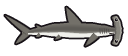
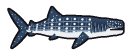
The Fish Around catalog also has the whale shark and the scalloped hammerhead. All three are sharks, yet their size and way of life could hardly be more different.
People and this fish
It is harmless to people and so slow-moving that divers can catch it by hand — though it is still wise to watch out for the fin spines and its strong bite.
It is eaten in Japan, but only in small numbers. It is sometimes caught along with other fish in gillnets.
Because it does well in captivity, it is on show in many Japanese public aquariums, where you can watch it resting on the bottom or walking along on its fins.
In Fish Around
As a bottom-dweller, it stays in a band near the bottom of the screen and plods along slowly. The idea is the unhurried way a real bullhead shark walks across the sea floor on its fins.