About
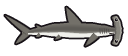
The front of its head is flattened and stretched out to each side into a T-shaped “hammer”, with an eye at each end. It is the most commonly seen of all the hammerheads, and it is famous for gathering in large schools.
The front edge of the hammer is gently rounded, with a clear notch in the middle and smaller dips on either side, so the outline looks wavy. The back is grey-brown to bronze, the belly is white, and the first dorsal fin is tall and pointed. Most adults are around 3 m long, and the largest pass 4 m.
Nobody is quite sure what the hammer is for, and there are several ideas. Like all sharks, it has sense organs called ampullae of Lorenzini that pick up the faint electric fields given off by living prey. A wide head spreads these sensors over a broader strip, so the shark can sweep more of the sea floor at once. Other suggestions are that the widely spaced eyes give it better depth perception straight ahead, and that the head helps it turn. The hammer probably does several of these jobs rather than just one.
Name
“Scalloped” describes the wavy front edge of the hammer, which looks like the rim of a scallop shell. The genus name Sphyrna comes from the Greek for “hammer”, so both the English and the scientific names point to the same feature.
In Japanese it is called aka-shumoku-zame. A shumoku is the T-shaped wooden striker used to sound a temple bell.
Life
It lives in warm seas all around the world, from the tropics to warm temperate waters. It comes into coastal bays, but it is also found around offshore islands and seamounts. It usually stays in the top 25 m or so, yet it can dive deeper than 500 m.
Adults may swim alone, in pairs or in small groups, and at some sites they form schools of dozens to hundreds. Tracking studies around islands and seamounts have shown a daily rhythm: the sharks school there during the day, then split up at night and head out into open water to feed.
It eats fish such as sardines and mackerel, as well as squid, octopus, shrimp, crabs and even other sharks and rays. When it finds a stingray on the bottom, it is said to pin it down with its head before eating it.
It gives birth to live young, which grow inside the mother for close to a year. A litter can be anything from about a dozen to around 40 pups. They are born in shallow, sheltered places such as mangrove-lined bays, where they stay for a while as they grow. These nursery areas are used again year after year, and the mother does not look after her young.
Look-alikes
Two other hammerheads live in Japanese waters too. The smooth hammerhead (Sphyrna zygaena) is greyer and has no notch in the middle of its hammer. The great hammerhead (Sphyrna mokarran), the largest of the family, has an almost straight front edge, giving its head a crisp T shape.
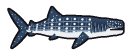
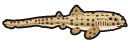
The Fish Around catalog also has two other sharks: the whale shark and the bullhead shark.
People and this fish
For divers, a school of hammerheads is one of the great sights of the ocean. In Japan, Yonaguni Island in winter and spring and Mikomotojima, off the Izu Peninsula, in summer and autumn are both well known for them. It rarely approaches people and is usually not aggressive towards divers, though it is still a large shark that is best given some space.
Fishing, however, has hit it hard. Its fins fetch high prices in the shark-fin trade, and its meat has been used in fish paste products in Japan. Because it gathers in schools, many can be caught in a single net.
The IUCN Red List classes it as Critically Endangered, the highest level of threat, and international trade in it is now controlled under CITES.
In Fish Around
Drawn as a wide sprite to match its size. Seen straight from the side the hammer would disappear, so the head alone is drawn as if seen slightly from above, showing the eyes at both ends. It cruises along at a steady, unhurried pace with its tall dorsal fin raised, much like a real school circling a seamount by day.