
About
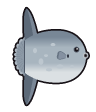
The ocean sunfish looks as if someone forgot to finish it. Its body is a flat, tall oval that seems to stop abruptly behind the middle, as though the back half had been sliced off. A tall, narrow dorsal fin rises from its back, and an almost identical anal fin hangs below, so the fish looks the same upside down.
There is no ordinary tail fin. The tail is lost as the young fish grows, and in its place parts of the dorsal and anal fins are thought to wrap around the rear edge of the body to form a stiff, rudder-like fin called the clavus. In this species the edge of the clavus carries a row of small bony knobs (ossicles), which give it a wavy, scalloped outline.
The back is grey to bluish grey, and the belly is a lighter silvery grey. The skin is thick and rough, with scales that are hard to see.
At the front of the head sits a small, puckered mouth whose teeth are fused into a beak-like plate. The eye is small and round. The pectoral fin is small and rounded, with a single small gill opening just in front of it.
When it swims, the sunfish barely bends its body. Instead it sweeps the dorsal and anal fins from side to side together. They swim more strongly than their clumsy look suggests.
Name
The genus name Mola is Latin for “millstone”, a nod to its round, grey, rough-skinned body. The English name “sunfish” is said to come from its habit of lying on its side at the surface, as if sunbathing.
The Japanese name, manbō, has several proposed origins and none is settled. It is sometimes written with characters meaning roughly “overturned-cart fish”.
Life
Ocean sunfish live in the open ocean in tropical and temperate waters around the world. They have a reputation for drifting lazily at the surface, but tagging studies show that they move up and down a great deal. They dive several hundred metres to feed and are thought to return to warmer surface water to heat up again.
They are also famous for lying flat at the surface. Besides warming up, this may let seabirds pick parasites off their skin.
They were long thought to eat almost nothing but jellyfish. More recent studies show that they also eat small crustaceans and small fish, and that younger sunfish eat more crustaceans while larger ones take more jellyfish and other soft, gelatinous animals.
The species is known for laying enormous numbers of eggs; one female was reported to carry around 300 million. The newly hatched young are only a few millimetres long and covered in spines, looking nothing like their parents.
Look-alikes
The fish most often confused with it is the bump-head sunfish (Mola alexandrini). Large adults develop a bump on the head and another under the chin, and the edge of the clavus is smooth rather than wavy. The often-quoted record of a sunfish weighing about 2.3 tonnes, long credited to the ocean sunfish, was later identified as a bump-head sunfish. A third species, the hoodwinker sunfish (Mola tecta), found mainly in the Southern Hemisphere, was described in 2017.
The sharptail mola (Masturus lanceolatus), from the same family, is easy to separate: the middle of its clavus sticks out backwards in a point.
Sunfish belong to the same order as pufferfish. In the Fish Around catalog, the porcupinefish and the yellow boxfish are distant relatives.
People and this fish
With its huge size and strange shape, the ocean sunfish is a popular aquarium animal and is on show at several aquariums, including Kaiyukan in Osaka. Much about its life is still unknown, though, and it is known as a difficult fish to keep. Some aquariums hang plastic curtains in the tank so the fish does not bump into the walls.
In Japan, sunfish caught in set nets are eaten as a local dish where they are landed. The meat spoils quickly, so it rarely reaches markets elsewhere.
At the same time, many sunfish are caught by accident in nets meant for other fish, and populations are thought to be falling. The IUCN Red List classifies the species as Vulnerable (VU).
In Fish Around
The sunfish uses a taller sprite than most fish, showing the rounded, cut-off body and the tall dorsal and anal fins standing above and below it. In place of a tail fin, a clavus wraps around the rear of the body, with a scalloped edge for its bony knobs.
Seen from the side, a side-to-side fin stroke looks like the fin tip swinging forwards and back while the fin narrows and widens again, so that is how the fins move. The body hardly bends, and the edge of the clavus ripples slightly as the big fish cruises along slowly at a steady pace.


