
About
The trumpetfish looks more like a stick than a fish. Adults are usually around 60 cm long and can reach about 80 cm, yet the body is only about as deep as a finger. It is also flattened from side to side, so from the side it looks like a long, narrow board.
The front of the head stretches into a long tube with a small mouth at the tip. When prey comes close, the mouth flares open and sucks the victim into the tube along with a gulp of water. The long snout is thought to let the fish snap up small fish from a surprising distance. A short barbel hangs from the tip of the lower jaw.
Its fins are arranged in an unusual way too. Along the back runs a row of short, separate spines. The soft-rayed dorsal fin and the anal fin sit far back on the body, facing each other just in front of the tail, and the tail fin itself is a small, rounded fan. Most of the time the fish keeps its body straight and glides forward by rippling those rear fins.
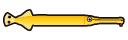
Most trumpetfish are drab brown, grey or greenish, sometimes with thin pale lines or blotches. There is also a striking all-yellow form that stands out on the reef. In the yellow form a dark line runs along the upper jaw, and the tail fin carries round black spots — usually one near the top and one near the bottom, though some fish show only the upper spot.
Name
The Japanese name, hera-yagara, joins hera — a flat spatula used in cooking — with yagara, “arrow shaft,” a name given to several long, slender fishes. The spatula is usually explained as a reference to the flattened body (or to the long, flat mouth).
The English name compares the tubular snout to a trumpet. The family name Aulostomidae and genus name Aulostomus come from the Greek for “flute” and “mouth,” another nod to that pipe-like snout. The species name chinensis means “of China”; the species was described by Linnaeus in 1766.
Life
The Chinese trumpetfish has a huge range across the Indian and Pacific Oceans, from East Africa to Hawaii and Easter Island. In Japan it lives along the coasts of the south. It is mainly a fish of coral and rocky reefs and has been recorded from very shallow water down to more than 100 m.
It eats small fish and small crustaceans such as shrimp. It is not a strong swimmer, so rather than chasing prey it relies on getting close without being noticed.
Its best-known trick is hanging head-down in the water, perfectly still. Tucked among sea fans, sea whips or branching corals, its thin body looks like just another branch, and it waits for prey to drift within reach.
Its other trick is shadowing. A trumpetfish will press itself against the side of a larger fish — often a plant-eater that small fish do not fear — and travel along with it. Hidden behind its escort, it closes in on prey that never sees it coming, then darts out and sucks it in. This behavior has been studied in detail in a close relative from the Atlantic, where researchers confirmed that the trumpetfish uses the other fish as cover.
Trumpetfish usually live alone. Their eggs are released into the water, and the small, round eggs are thought to drift in the open sea as they develop.
Look-alikes
The fish most often confused with it is the cornetfish (Fistularia), which also has a long, thin body and a tube snout. A cornetfish has a long thread trailing from the middle of its tail, which the trumpetfish lacks. The cornetfish’s body is round like a pipe, while the trumpetfish’s is flattened side to side — and only the trumpetfish has a chin barbel.
The Atlantic Ocean has a very similar species, the Atlantic trumpetfish (Aulostomus maculatus). The two live in different oceans, so where you see one tells you which it is.
Trumpetfish belong to the same broad group of tube-snouted fishes as the crowned seahorse and the leafy seadragon. They look nothing alike, but all of them suck in prey through a small mouth at the end of a tube.
People and this fish
Because it is common even on shallow reefs, the trumpetfish is a familiar sight for divers and snorkelers. The yellow form is especially eye-catching and a favorite subject for underwater photographers, and spotting one hanging upside down among the sea fans is part of the fun of a reef dive.
It grows large and feeds on live fish, so it is rarely kept in home aquariums, though public aquariums sometimes show it in big reef tanks.
It is seldom sold as food, although it is eaten in some places. The IUCN Red List lists it as Least Concern.
In Fish Around
We drew the eye-catching yellow form. The stick-like body fills a wide sprite, with the tube snout, the small mouth at its tip, the short barbel hanging from the lower jaw and the dark line along the upper jaw. The dorsal and anal fins sit far back and face each other, tallest at the front edge and sloping toward the tail, and the rounded fan of a tail fin carries one black spot near the top and one near the bottom.
The row of short spines along the back is left out: at this size the outline turns them into something like saw teeth.
It swims with the unhurried cruise motion. The body barely bends; a wave runs through the rear fins and only the base of the tail sways, so the fish glides along like a drifting stick.


