
About
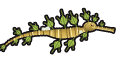
A slender fish that floats with its body held level, trailing seaweed-like leafy flaps from all over its body as it drifts through the water. It belongs to the same family as seahorses, and the largest grow to around 35 cm long.
Its body is built much like a seahorse’s. Instead of scales it is covered in rings of bony plates that line up like segments, and a long, tube-shaped snout points straight ahead from the front of its head. Unlike a seahorse, though, it does not stand upright; it hangs in the water with its body almost horizontal.
Its most famous feature is the many leaf-like flaps growing from its head, neck, back, belly and tail. These are thin outgrowths of skin that branch at the end of a slender stalk and have gently wavy edges. They are not fins and play no part in swimming. They are thought to work as camouflage, breaking up the outline of the body among the weed.
The body is yellowish-brown to greenish, and the leafy flaps are green to yellow-green. Thin pale bands run across the body. Its colour is said to vary with things like age and location, and it usually matches the seaweed around it.
What actually moves it are two small fins: a pectoral fin on each side of the neck and a dorsal fin towards the back. Both are clear and almost invisible, and the fish flutters them to inch slowly forward. The result looks like nothing more than a torn piece of seaweed drifting on the swell.
Name
The common name is simple: a sea dragon covered in leaves. The long face and armoured body are what make people think of a dragon.
The genus name Phycodurus is built on a Greek word for seaweed, a nod to the weedy flaps that decorate its body. The species name eques is Latin for a horseman or knight.
Life
It is found only along the coasts of southern and south-western Australia. It lives on rocky reefs thick with seaweed, as well as in nearby seagrass beds and over sand patches, mostly at depths of about 4–30 m.
It feeds on tiny crustaceans such as mysid shrimps. Having no teeth, it sucks prey into its tube snout in an instant. It also has no real stomach, so it is thought to spend most of the day hunting for food.
Unlike a seahorse, it cannot wrap its tail around seaweed to hold on. Instead it drifts slowly among the weed, shifting its position a little at a time.
As with seahorses, it is the male that looks after the eggs. But a leafy seadragon has no pouch. The female lays her eggs onto a soft patch on the underside of the male’s tail. There can be a few hundred of them, and the male carries them for roughly one to two months until they hatch. The young look like small versions of their parents and fend for themselves straight away.
Look-alikes
Its closest look-alike is the weedy seadragon (Phyllopteryx taeniolatus), which also lives in southern Australia. It is reddish with yellow spots and bluish-purple bands, and its leafy flaps are much smaller and fewer. If the fish looks as though it is wrapped in leaves, it is a leafy; if it is sleek with only modest flaps, it is a weedy.
In 2015 a third species, the ruby seadragon (Phyllopteryx dewysea), was described. It lives in deeper water, is red all over, and has no leafy flaps at all.
Its relative the crowned seahorse is easy to tell apart at a glance: the seahorse stands upright, grips things with its tail and has no leafy flaps.
People and this fish
Its looks often earn it a place on lists of the world’s most beautiful fish, and it is a favourite with divers in southern Australia. It is also the official marine emblem of the state of South Australia.
Concern about collecting for the aquarium trade and the loss of weedy habitat led to legal protection, and today it cannot be collected in Australia without a permit. Seadragons are also known to wash up in the shallows after storms.
Aquariums in places such as the United States and Japan sometimes display them, but they are known to be very difficult to keep, and breeding them in captivity is far from easy.
In Fish Around
It is drawn in a wider-than-usual frame with its body held level, head to the right and its long tube snout pointing straight ahead.
Fourteen leafy flaps sprout from its head, throat, back, belly and tail, each splitting into three leaves at the end of a slender stalk. Rather than being driven by swimming, they sway as if rocked by the water, each leaf slightly out of step with the next. The body is yellowish-brown with lines marking the bony rings and thin pale bands, and the leaves are green to yellow-green.
The pectoral fin behind the head and the dorsal fin towards the back are drawn as small see-through fins that flutter faster than the leaves. The body barely bends and only bobs gently up and down, so it moves along at a slow drift.


